
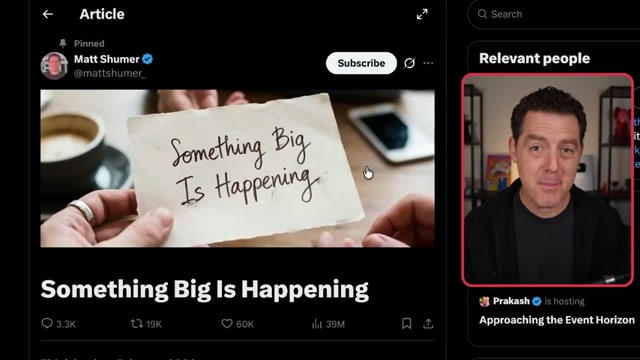
📺 Original Video: Something big is happening… by Matthew Berman
📅 Duration: 20:12 · Published: February 12, 2026
TL;DR
- Matt Schumer’s viral article (40M views) compares AI’s current acceleration to early 2020 — one day it’s distant, three weeks later it’s everywhere
- GPT 5.3 Codex and Opus 4.6 (released Feb 5, 2026) represent a step change: engineers are now automating their entire jobs, not just getting help
- A few hundred researchers at OpenAI, Anthropic, and DeepMind control the future, and even they’re surprised by the pace
- White collar work across legal, writing, marketing, software, and medical fields faces massive disruption by end of 2026
- Actionable advice: pay for frontier models ($20/mo), actually use them for real work, get your finances in order, and lean into what’s hard to replace (hands-on work, taste, accountability)
The Article Everyone’s Talking About
▶00:00 The Article Everyone’s Talking About.
Matthew Berman breaks down Matt Schumer’s viral piece “Something big is happening” — and yeah, he’s not exaggerating. The central analogy? Remember early 2020? One day you’re reading about something weird happening far away. Three weeks later, the world is completely different.
That’s where we are with AI right now. Not in five years. Not “eventually.” Right now.
The trigger? Recent releases like OpenClaw, GPT 5.3 Codex, and Opus 4.6 feel like genuine leaps, not incremental updates. Berman himself has automated huge chunks of his video production workflow in minutes. ▶00:49
A Few Hundred People Control Everything
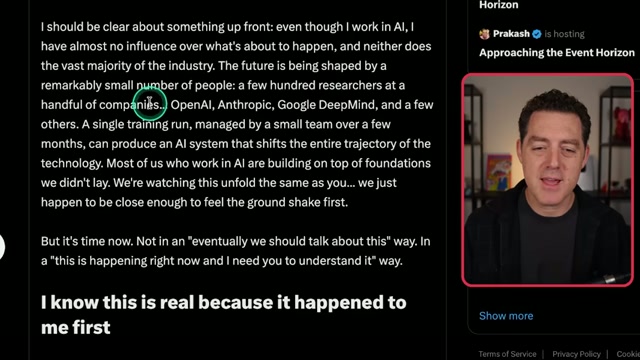
▶01:22 A Few Hundred People Control Everything.
Here’s the uncomfortable truth: the future is being shaped by maybe a few hundred researchers at OpenAI, Anthropic, Google DeepMind, and a couple other labs.
Matt Schumer runs an AI company. Matthew Berman covers AI daily. And even they admit: we have almost zero control over what’s coming. It’s being decided by a tiny group of people, and the rest of us are just along for the ride. ▶01:51
Schumer’s message isn’t “we should talk about this eventually.” It’s “this is happening right now and I need you to understand it.“
What Changed: Engineers Don’t Code Anymore
▶02:27 What Changed: Engineers Don’t Code Anymore.
Matt Schumer’s personal experience is wild. A year ago, AI was a helpful coding assistant. You’d write code, it would suggest completions, nice productivity boost.
Now? You give it a task. It disappears for minutes or hours. It does research, makes decisions, has opinions about your codebase. Then it comes back with the finished work. No human input except the initial prompt and final review.
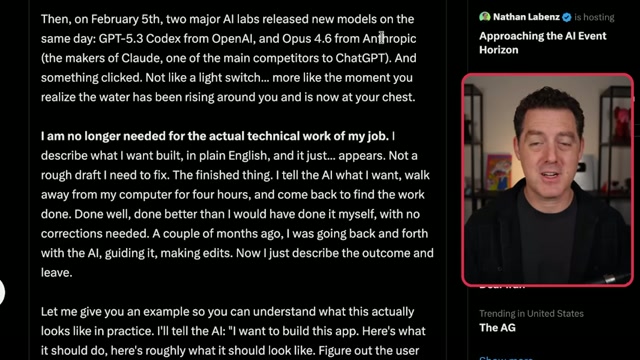
▶03:11 GPT 5.3 Codex and Opus 4.6 are different. People keep saying it: these aren’t just better, they’re qualitatively different. You describe what you want, walk away, come back to find it done.
“I Am No Longer Needed for the Actual Technical Work”
▶03:31 “I Am No Longer Needed for the Actual Technical Work”.
That’s Matt Schumer talking. A guy who writes code for a living at his AI startup. He’s not needed for the technical work anymore. He just instructs agents and they execute.
Berman feels the same way. He doesn’t write software for a living, but his entire video production workflow? Automated. Research, scripting, organization — everything except talking to the camera and editing. ▶04:01
▶04:33 Schumer’s description: “I describe what I want in plain English, and it just appears. Not a rough draft I need to fix. The finished thing. I walk away for four hours and come back to find it done well, done better than I would have done it myself, with no corrections needed.“
“But I Tried AI and It Sucked”
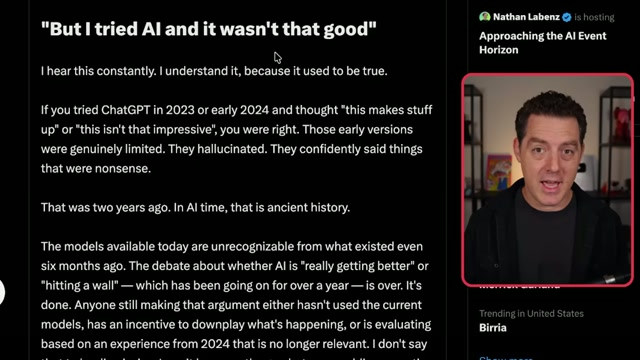
▶05:04 “But I Tried AI and It Sucked”.
If that’s you, two questions:
- When was the last time you tried? If it wasn’t in the last few months, you’re out of date. Things are moving that fast.
- Are you using the free tier? Because free ChatGPT isn’t the frontier. You’re getting a worse model.
▶05:40 Pay the $20/month. Use ChatGPT Plus, Claude Pro, or Gemini Advanced. And don’t just use it as a search replacement — give it actual work. Tell it to complete real tasks.
The Timeline Is Insane
▶06:22 The Timeline Is Insane.
Quick progression:
- 2022: AI couldn’t do basic arithmetic (7 × 8 = 54… nope)
- 2023: Passed the bar exam
- 2024: Writing working software, explaining graduate-level science
- Late 2025: Top engineers handing over most coding work to AI (including OpenClaw’s founder)
- February 5, 2026: Opus 4.6 and GPT 5.3 Codex drop within 15 minutes of each other, making everything before feel ancient
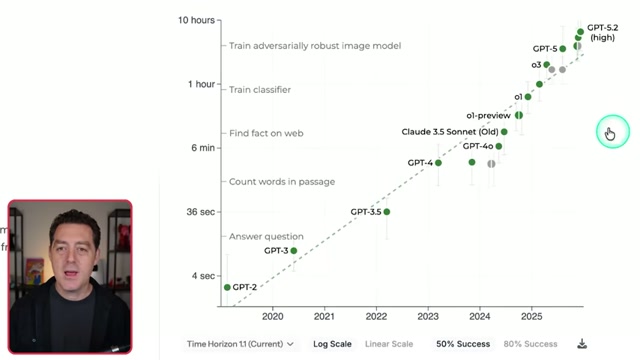
▶07:26 Berman references METR (a benchmark measuring how long AI can work autonomously on real tasks):
- GPT-3: seconds
- GPT-3.5: half a minute
- GPT 5.2 High: way longer
- Newest models: off the charts
The chart’s on a log scale. Switch it to linear and it’s a vertical wall. 5.3 Codex and Opus 4.6 are even higher.
Real-World Case Studies
▶08:46 Real-World Case Studies.
Anthropic: Built a C compiler using parallel Claude agents. 16 agents, 2,000 Claude Code sessions, a $20,000 API bill, and a 100,000-line compiler that actually works. Ran autonomously for two weeks.
▶09:46 Cursor CEO Michael Truel: Built a browser using GPT 5.2 (not even 5.3). Ran for one week straight, producing 3 million lines of code across thousands of files.
Recursive Self-Improvement Is Here
▶10:09 Recursive Self-Improvement Is Here.
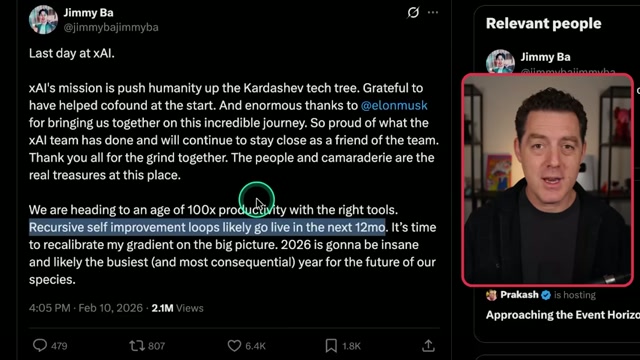
OpenAI’s blog post on 5.3 Codex: “Our first model that was instrumental in creating itself.“ The Codex team used early versions to debug training, manage deployment, and diagnose test results.
That’s recursive self-improvement. Not a future concern. Happening now.
▶10:43 Jimmy Bob (ex-cofounder of XAI): “We are headed to an age of 100X productivity with the right tools. Recursive self-improvement loops likely go live in the next 12 months.“
What It Means for You
▶11:16 What It Means for You.
Dario Amodei (CEO of Anthropic): predicts a “white collar bloodbath“ in the next 3-5 years.
Matt Schumer thinks that’s conservative. Given what the latest models can do, mass disruption could hit by the end of 2026.
▶11:43 This wave is different. Previous automation let people retrain:
- Factory workers → office jobs
- Retail workers → logistics and services
But AI is a general substitute for cognitive work. Whatever you retrain for, it’s improving at that too. There’s no obvious “safe” field to pivot into.
▶12:17 Berman pushes back a bit: he thinks there will be new jobs focused on taste, authenticity, and critical decision-making where humans are needed “because people want somebody to blame.”
What Gets Automated
▶12:40 What Gets Automated.
Categories facing complete automation:
- Legal work
- Writing and content
- Marketing, copywriting, reports, journalism, technical writing
- Software engineering
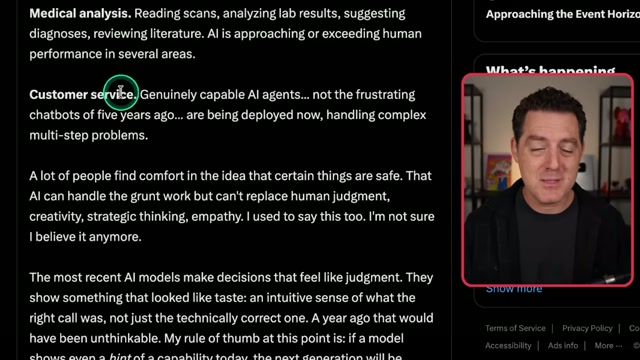
- Medical analysis
- Customer service (already the most disrupted)
▶13:40 Can AI replicate deep human empathy? Schumer knows multiple people already using AI for emotional support. His take: “Nothing that can be done on a computer is safe in the medium term. And eventually robots will handle physical work too.”

So What Should You Do?
▶14:17 So What Should You Do?.
Get to the Frontier
Use the tools. Actually use them. Explore what they’re great at and where they fail. Start automating parts of your life and work. Become an expert at AI.
▶14:58 Don’t use AI as a replacement for what you’re already doing. Figure out what it can actually do for you. Push it to do your real work.
Become Valuable
▶15:18 Become Valuable.
Most companies don’t know what’s happening. A McKinsey report found only 7% of companies have fully scaled AI deployments. If you know even a little about implementing these tools, you’ll be incredibly valuable.
Drop Your Ego
▶15:56 Drop Your Ego.
You might have to let go of things tied to your identity. Imagine training your whole life to be an engineer, then over one year you no longer write code. That’s where we are.
Get Your Finances in Order
▶16:22 Get Your Finances in Order.
Build savings. Be cautious about debt that assumes your current income is guaranteed. Give yourself options.
Lean Into What’s Hard to Replace
▶16:51 Lean Into What’s Hard to Replace.
- Anything with your hands
- Taste and judgment
- Relationships
- Licenses and permits
- Roles requiring accountability and sign-off — companies won’t offload that to AI yet
Rethink Advice for Kids
▶17:37 Rethink Advice for Kids.
Let them study what they’re passionate about. Get them fluent with these tools. Foster their agency.
Your Dreams Just Got Closer
▶18:20 Your Dreams Just Got Closer.
Want to start a business? Build something incredible? There’s never been a better time. The amount you can accomplish as a solo entrepreneur is greater than ever.
Final Thoughts
▶19:10 Final Thoughts.
Berman’s closing: this is very real. Things accelerate every day. He covers AI daily and can’t keep up. He literally can’t sleep at night.
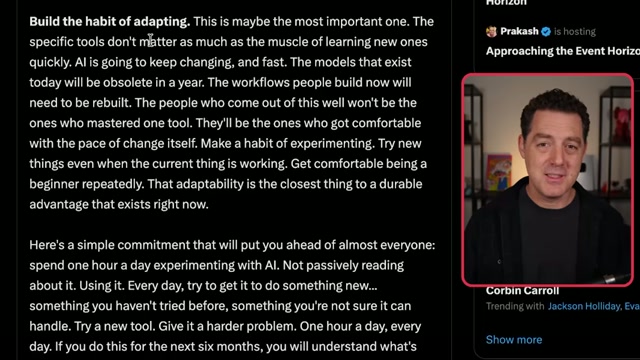
His one recommendation: start using the tools. Not the free version of ChatGPT. Pay the $20/month. Try a frontier model. Find out what’s possible for automating your life and work.
The window to prepare is shrinking. The people on the inside are telling you: something big is happening. Listen.
—
We try hard to get the details right, but nobody’s perfect. Spot something off? Let us know